
NEET Physics Syllabus 2027: Complete Chapter-Wise Guide
Preparing for NEET UG requires a clear understanding of the complete syllabus, especially Physics, which is considered one of the most scoring yet challenging subjects. If you are searching for the NEET Syllabus 2027 Chapter Wise, then this detailed guide will help you understand the complete NEET Syllabus 2027 Physics section along with chapter-wise topics, weightage, preparation strategy, and important resources.
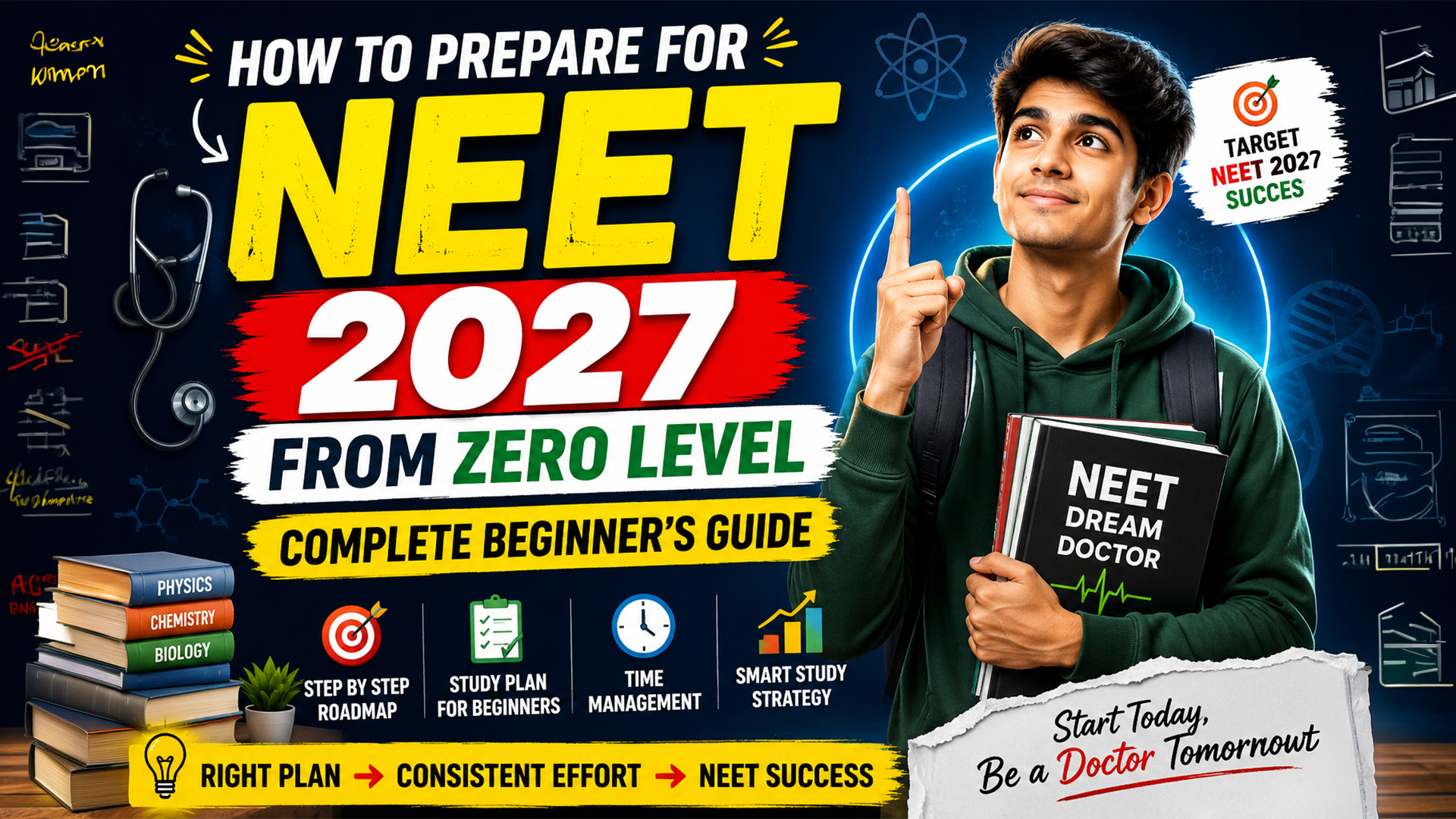
With Re-NEET UG 2027 scheduled on 21 June 2026, students should now focus on completing and revising the entire NEET Syllabus 2027 Chapter Wise to maximize their score. Physics demands conceptual clarity, numerical practice, formula memorization, and regular mock test analysis.
At Rajeev Dixit Career Institute (RDCI), students receive structured guidance, expert mentorship, test series, study materials, and app-based learning to master the complete NEET Syllabus 2027 effectively.
Students can also download the RDCI NEET Prep App from the Play Store and start preparing smartly to turn their dream of becoming a doctor into reality.
Why Understanding NEET Syllabus 2027 Chapter Wise is Important?
Before starting preparation, every aspirant should understand the complete NEET Syllabus 2027 Chapter Wise because it helps in:
- Identifying high-weightage chapters
- Planning effective revision schedules
- Improving conceptual understanding
- Increasing question-solving speed
- Strengthening weak topics
- Maximizing exam score
A proper understanding of the NEET Syllabus 2027 can significantly improve overall preparation strategy.
NEET Physics Syllabus 2027 Chapter Wise
Physics and Measurement
- SI Units and Measurements
- Fundamental and Derived Units
- Dimensions and Dimensional Analysis
- Errors in Measurement
- Significant Figures
- Least Count and Precision
Kinematics
- Motion in One Dimension
- Motion in Two Dimensions
- Projectile Motion
- Relative Velocity
- Uniform Circular Motion
- Vector Algebra
Laws of Motion
- Newton’s Laws
- Force and Inertia
- Momentum
- Impulse
- Friction
- Circular Motion
- Banking of Roads
Work, Energy and Power
- Work Done
- Kinetic Energy
- Potential Energy
- Conservation of Energy
- Power
- Elastic and Inelastic Collisions
Rotational Motion
- Centre of Mass
- Torque
- Angular Momentum
- Moment of Inertia
- Radius of Gyration
- Rotational Equilibrium
Gravitation
- Universal Law of Gravitation
- Escape Velocity
- Satellite Motion
- Kepler’s Laws
- Gravitational Potential
Properties of Solids and Liquids
- Elasticity
- Young’s Modulus
- Surface Tension
- Viscosity
- Bernoulli’s Principle
- Calorimetry
Thermodynamics
- Thermal Equilibrium
- First Law of Thermodynamics
- Second Law of Thermodynamics
- Isothermal Process
- Adiabatic Process
Kinetic Theory of Gases
- Equation of State
- RMS Velocity
- Degrees of Freedom
- Equipartition of Energy
- Mean Free Path
Oscillations and Waves
- Simple Harmonic Motion
- Wave Motion
- Standing Waves
- Resonance
- Beats
- Organ Pipes
Electrostatics
- Coulomb’s Law
- Electric Field
- Electric Potential
- Capacitors
- Gauss’s Law
- Dielectrics
Current Electricity
- Ohm’s Law
- Resistance and Resistivity
- Kirchhoff’s Laws
- Wheatstone Bridge
- Electrical Power
- Cells and Batteries
Magnetic Effects of Current and Magnetism
- Biot-Savart Law
- Ampere’s Law
- Magnetic Field
- Galvanometer
- Magnetic Materials
Electromagnetic Induction and Alternating Current
- Faraday’s Law
- Lenz’s Law
- AC Circuits
- Transformers
- Inductance
- Reactance and Impedance
Electromagnetic Waves
- EM Spectrum
- Radio Waves
- Microwaves
- Infrared Rays
- X-Rays
- Gamma Rays
Optics
- Reflection
- Refraction
- Mirrors and Lenses
- Wave Optics
- Diffraction
- Polarization
- Optical Instruments
Dual Nature of Matter and Radiation
- Photoelectric Effect
- Einstein Equation
- de Broglie Hypothesis
- Matter Waves
Atoms and Nuclei
- Rutherford Model
- Bohr’s Theory
- Nuclear Binding Energy
- Nuclear Fission
- Nuclear Fusion
Electronic Devices
- Semiconductors
- Diodes
- Rectifiers
- LED
- Solar Cell
- Logic Gates
Experimental Skills
- Vernier Calipers
- Screw Gauge
- Meter Bridge
- Ohm’s Law Experiment
- Prism Experiment
- Focal Length Measurement
- Diode Characteristics
NEET Physics Chapter-Wise Weightage 2027

| Physics Chapter | Average Questions | Weightage |
|---|---|---|
| Current Electricity | 5 | 10% |
| Rotational Motion | 3 | 6% |
| Ray Optics | 3 | 6% |
| Semiconductor Electronics | 3 | 5% |
| Units and Measurements | 3 | 5% |
| Electrostatic Potential & Capacitance | 3 | 5% |
| Moving Charges & Magnetism | 2 | 5% |
| Nuclei | 2 | 4% |
| Alternating Current | 2 | 4% |
| Mechanical Properties of Fluids | 2 | 3% |
| Electromagnetic Waves | 2 | 3% |
| Dual Nature of Matter | 2 | 3% |
| Gravitation | 2 | 3% |
| Work Energy and Power | 2 | 3% |
These trends are based on previous years’ analysis and can help students prioritize the NEET Syllabus 2027 Chapter Wise more efficiently.
Best Resources for NEET Physics Preparation 2027
| Resource | Purpose |
|---|---|
| Physics Notes | Concept Clarity |
| Formula Sheets | Quick Revision |
| Chapter-wise MCQs | Practice |
| Previous Year Questions | Exam Pattern Understanding |
| Mock Tests | Time Management |
| Mind Maps | Fast Revision |
RDCI provides all these resources to help students complete the entire NEET Syllabus 2027 systematically.
How RDCI Helps Students Crack NEET 2027
Rajeev Dixit Career Institute (RDCI) offers:
- Expert Faculty Guidance
- Chapter-wise Study Material
- Daily Practice Questions
- NEET Mock Test Series
- Doubt Solving Sessions
- Performance Analysis
- App-Based Learning
Download the RDCI NEET Prep App from the Play Store and begin your journey towards becoming a successful doctor.
The app is specially designed to help students cover the complete NEET Syllabus 2027 Chapter Wise through structured learning and regular assessments.
NEET Physics Syllabus 2027 FAQs
1. Is the NEET Syllabus 2027 changed?
The NEET Syllabus 2027 remains largely aligned with the latest NCERT curriculum. Students should always check the latest official notification for updates.
2. How many chapters are there in NEET Physics Syllabus 2027?
The NEET Syllabus 2027 Chapter Wise Physics section consists of approximately 20 major units covering Class 11 and Class 12 Physics topics.
3. Which chapter has the highest weightage in NEET Physics?
Current Electricity generally carries the highest weightage in the NEET Syllabus 2027 Physics section.
4. Is NCERT enough for NEET Physics 2027?
NCERT is the foundation, but additional MCQs, PYQs, and mock tests are essential for mastering the NEET Syllabus 2027 Chapter Wise.
5. Which topics should I revise first for NEET 2027?
Start with Current Electricity, Optics, Modern Physics, Electrostatics, and Rotational Motion.
6. How can I complete the NEET Syllabus 2027 on time?
Follow a chapter-wise study plan, solve MCQs daily, revise formulas regularly, and attempt mock tests.
7. Are numerical questions important in NEET Physics?
Yes. Numerical-based questions form a significant portion of the NEET Syllabus 2027 Physics examination.
8. How many Physics questions are asked in NEET?
Typically, 45 Physics questions are asked in the NEET examination.
9. What is the best way to revise Physics formulas?
Use formula sheets, mind maps, and regular practice sessions for effective retention.
10. Which coaching institute is best for NEET Physics preparation?
Rajeev Dixit Career Institute (RDCI) provides comprehensive guidance, study materials, test series, and app-based preparation for the complete NEET Syllabus 2027 Chapter Wise.
Contact RDCI
📞 Admission & Enquiry: +91 9451935245
🌐 Website: http://www.rdciindian.com
RDCI For Neet Student :
- Exam Preparation Strategies
- Study Tips & Motivation
- Subject-Wise Classes
- Career Guidance
- Student Success Stories
- Latest Educational Updates
Join RDCI today and take the first step towards your dream career.
Download the RDCI NEET Prep App from the Play Store, master the complete NEET Syllabus 2026 Chapter Wise, and make your dream of becoming a doctor a reality.
Related Search :-
Pingback: How to Prepare for NEET 2027 from Zero Level - Rajeev Dixit Career Institute
ohxqtmldekstylsujgjpjrvdplrsgl